Silent Patriotism and the Busted NRI Bonanza
After thirty-eight years in the bank, people often ask me to name my most treasured moment. They expect tales of massive recoveries or aggressive profit targets. While those were part of my journey, my favorite one was an act of "Silent Patriotism"—one that took place in the quiet of my office as a Zonal Manager in Bombay, fueled by a stubborn curiosity that even the Reserve Bank of India (RBI) initially tried to dismiss.
The NRE Anomaly
It was the end of the financial year, a high-pressure season for meeting targets. While reviewing the Bombay region, I noticed a suspicious trend. One particular Regional Manager, despite being well below her targets, was oddly confident about a "huge inflow" of deposits from a group of Non-Resident Indians (NRIs).
My curiosity was piqued when I learned that a retired colleague was facilitating these deposits by leveraging his old connections to secure "favorable conversion rates." The pattern was baffling: dollars were being converted to rupees, deposited into NRE (Non-Resident External) accounts, and then repatriated back into foreign currency just forty-eight hours later.
The Anatomy of the "Two-Step Tango"
As I dug deeper, I realized we were witnessing a massive exploitation of the newly introduced LERMS (Liberalised Exchange Rate Management System). A loophole existed between the "Official" rate and the "Market" rate.
Speculators were bringing in dollars at the high market rate (approx. ₹31), sitting on the funds for two days, and then remitting them back through overseas banks at a "Blended Rate" (approx. ₹29). This allowed them to pocket a risk-free profit of over 6.5% in just forty-eight hours. Every dollar cycled through this system was a direct drain on India’s foreign exchange reserves.
The Restless Conscience vs. The Bureaucracy
I called the RBI's Department of Banking Operations and Development (DBOD). The officer was dismissive, citing that NRE rules had been in vogue for decades. "What is your doubt?" he snapped. "Put it in writing."
I would have stopped there, deterred by the cold response of the regulator. But my "restless" feeling persisted. With no time for a formal memo, I sat with my assistant and a sheet of carbon paper. I dictated a handwritten letter detailing exactly how our national resources were being strained. I sent my PA to deliver it personally. The RBI refused to even provide an acknowledgment, as it wasn't "customary" for the Reserve Bank to acknowledge handwritten notes.
The Verdict: "No Prizes for Guessing"
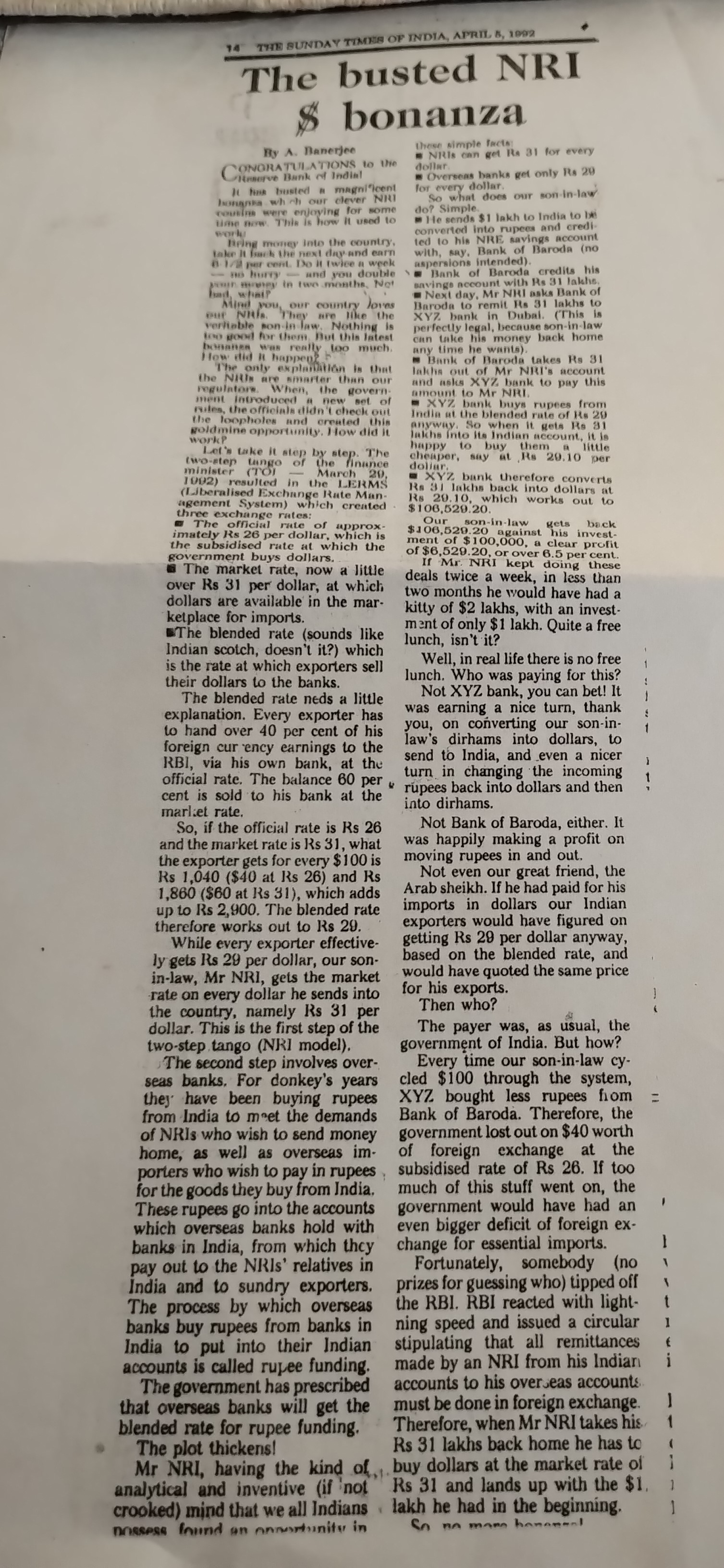
A few weeks later, I was in Madras for my General Manager promotion interview. As soon as the interview was over, the CMD said ‘NRN wait’. After a while he asked me ‘Did you write a letter to RBI’. I was nervous and guessed that RBI could have complained about my dialogue with one of its senior officer. I mumbled “Yes, it was regarding NRE accounts”. The Chairman reached into his pocket and pulled out a newspaper clipping titled, "The Busted NRI $ Bonanza."
The article explained that "somebody known to the Reserve Bank" had provided the tip-off that allowed the RBI to react with lightning speed to plug the loophole. The Chairman explained to the committee that my "unauthorized" handwritten note had saved the National Exchequer from a massive drain of foreign exchange.
EXHIBIT: THE SUNDAY TIMES OF INDIA (APRIL 5, 1992)
THE BUSTED NRI $ BONANZA - By A. Banerjee
Congratulations to the Reserve Bank of India! It has busted a magnificent bonanza which our clever NRI cousins were enjoying. The "two-step tango" created three exchange rates: the Official Rate (₹26), the Market Rate (₹31), and the Blended Rate (₹29).
While every exporter got ₹29 per dollar, the NRI was getting the market rate of ₹31 on every dollar sent into the country. By remitting the money back the next day through an overseas bank at the cheaper "Blended Rate," the NRI pocketed a clear profit of over 6.5 per cent in two days. Who was paying for this? Not the banks—the payer was the Government of India.
Fortunately, somebody (no prizes for guessing who) tipped off the RBI. The RBI reacted with lightning speed and issued a circular stipulating that all such remittances must be done at the market rate. So, no more bonanza.
The "After Effects" were swift. The unscrupulous clients lost their "free lunch," and the ambitious managers saw their phantom targets vanish. I learned that day that a banker’s duty is not just to his branch, but to his country.
I was selected for the post of General Manager and asked to relinquish my charge as quickly as possible to begin my new assignment. I left that office knowing that while the RBI never sent me a formal note or acknowledgement, my name—though unwritten—was etched into a policy that protected the economy of India. It was a reminder that sometimes, the most important work a banker does is the work that no one officially acknowledges.