The Birth of Corporate Healthcare and the Spirit of Partnership
"A visionary is one who can find his way by moonlight, before the rest of the world sees the dawn." — Oscar Wilde
"Leadership is the capacity to translate vision into reality." — Warren Bennis
Often, a banker’s sense of fulfillment is found not in his own ledger, but in the success of a client who dares to dream beyond the existing statutes. In the early 1980s, I found myself at the center of a project that would fundamentally change Indian healthcare. Dr. Prathap C. Reddy was contemplating a massive hospital under a unique model: Corporate Ownership. He envisioned a facility where Indian doctors, then slogging away for salaries abroad, could return home to practice world-class medicine while holding a stake in the institution's future.
The Scuffle in the Corridor
The project began with a literal scuffle. I remember a loud commotion outside my cabin. I peeped out to see Dr. Reddy and Mr. Chacko (Executive Director of Spencer’s) in a heated exchange with our Merchant Banking officers. Dr. Reddy, a man of action, was shouting in frustration: "I am a doctor! I treat patients, I perform surgeries. I cannot manufacture papers after papers for the bank! I am fed up with waiting!"
My boss, equally frustrated by the administrative gridlock, pulled the file from the officer and handed it to me. "From now on, you handle this," he ordered. My portfolio was already overloaded, but the confidence my boss showed in my ability to handle "high-temperature" situations was a challenge I accepted. I immediately requested Mr. Chacko to be my primary liaison, ensuring that Dr. Reddy’s passion could remain focused on medicine while we navigated the bank’s internal hurdles.
The "Credit Squeeze" and the IDBI Dilemma
The banking environment then was under an unprecedented "Credit Squeeze." The RBI had placed a moratorium on credit expansion, and any term loan exceeding ₹25 lakhs required Prior Credit Authorization (PCA).
We looked for an escape route: If a project was eligible for refinance under the IDBI (Industrial Development Bank of India) Act, PCA was not required. However, Section 2 of the IDBI Act listed "Hotels" as an industry, but "Hospitals" were nowhere to be found.
Working with the data we compiled, Dr. Reddy took the case straight to the highest levels of government. He successfully argued that if a hotel is an industry, why not a hospital? His tenacity resulted in the PM agreeing to amend the IDBI Act. It was a historic shift, though it required navigating the "retrospective" trap of new statutes. It taught me that a banker's job often involves providing the technical ammunition for a client to fight for systemic change.
The Table Tennis Star Tragedy
Despite these hurdles, the consortium moved forward, the public issue was launched, and the term loans were syndicated. Apollo grew, and IOB even opened an extension counter within the campus—a sign of our growing partnership.
However, a crisis soon tested the institution's resilience. A well-known Table Tennis star underwent surgery at the hospital, during which an erratic power supply caused a "power dim" with disastrous neurological consequences for the patient. Apollo was sued for substantial damages. To prevent an instant, crippling payment from their strained cash flow, the bank stepped in with a Bank Guarantee on the spot. It was a moment where the bank acted as a shield, protecting a nascent and vital institution during its darkest hour.
A Legacy of Trust
Years later, I was shifted to a new assignment. To maintain professional boundaries and avoid embarrassing my successor, I stayed away from the new consortium meetings. However, the depth of the relationship was such that Dr. Reddy insisted on my presence. Our CMD, recognizing the importance of continuity, asked me to remain involved.
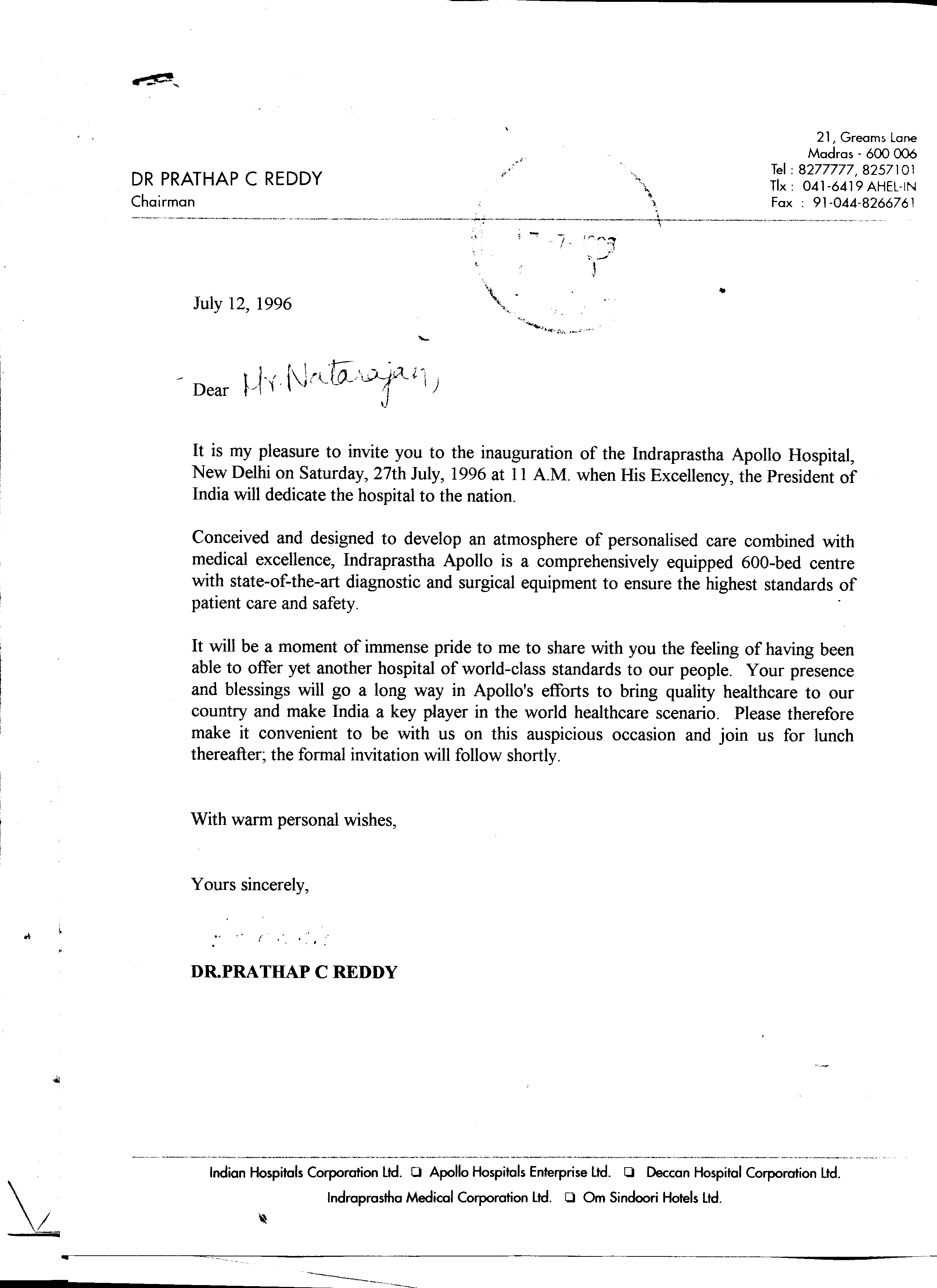
The most rewarding moment of this journey didn't come from a promotion, but from an invitation. When Dr. Reddy and Mr. Chacko established Indraprastha Apollo in Delhi, they sought my scrutiny of the project report at every stage—even when IOB did not have the "financial elbow room" to participate.
This experience was less about the complexity of the credit and more about the endurance of trust. It taught me three enduring lessons:
Navigating Friction: Realizing that professional disagreement is often just a stepping stone toward a common institutional goal.
Technical Partnership: The importance of helping a client to find a viable path through stringent credit squeezes and legislative gaps.
The Weight of Reputation: Understanding that a banker’s primary duty in a crisis is to provide a steady hand when a client’s reputation is on the line.
Later, being invited to the inauguration of landmark Indraprastha hospital, based on years of shared professional history, was a honor that I cherish. It was a reminder that when a bank and a visionary work in sync, they create something far more permanent than a financial transaction.